

Home and lifestyle D2C brands rely on product quality, design consistency and a memorable customer experience. When a brand sells bedding, quilts, cushion covers, throws, curtains, towels or table linen, the manufacturing details behind each product directly affect reviews, repeat purchases and returns. India is a sourcing market worth evaluating for private-label home textiles, provided the brand qualifies the factory and production process carefully.
What home textile products can D2C brands develop in India?
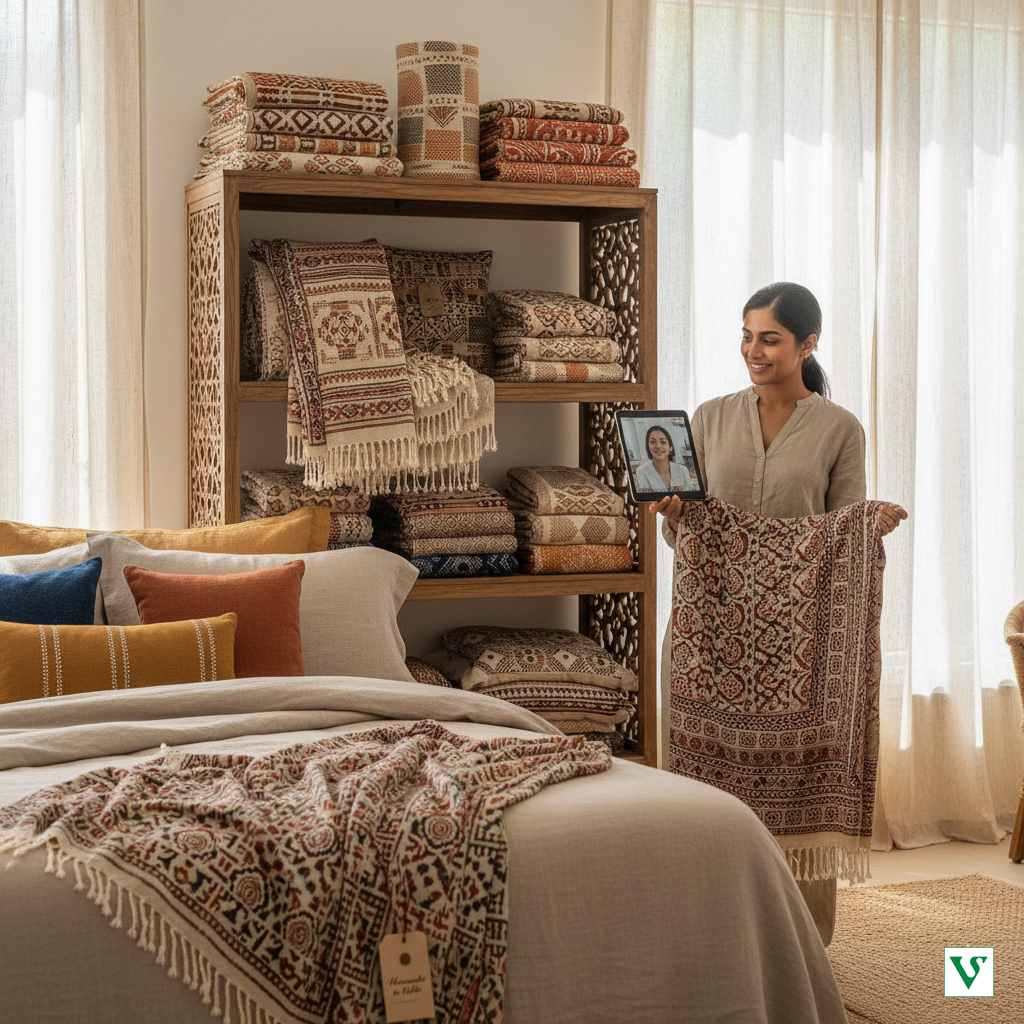
Indian manufacturers work across a broad range of textile constructions and product types. Depending on factory capability, buyers can explore bed sheets, duvet covers, quilts, bedspreads, cushion covers, throws, curtains, towels, table linen, woven mats and selected bath products. Product development may involve woven or knitted fabric, yarn-dyed or piece-dyed materials, printing, embroidery, quilting, finishing and sewing.
Choose the right supplier for the construction
The phrase “home textile factory” can describe very different operations. A mill that weaves fabric may not make finished quilts. A sewing unit may rely on external dyeing or printing. A rug producer may not have the equipment for bedding. Map the production chain and confirm which processes are controlled in-house, outsourced or handled by approved subcontractors.
Prepare a technical pack before requesting quotations
- Material composition, yarn or fabric construction, GSM or thread-count requirements where relevant.
- Finished measurements, tolerances, workmanship and seam or quilting details.
- Color standards, print artwork, placement, repeats and approved strike-offs.
- Label, care instructions, packaging, barcode and carton requirements.
- Testing protocol, quality acceptance criteria and destination-market rules.
Sample approval and bulk quality
Approve material swatches and construction samples before moving to a final pre-production sample. Check measurements, shrinkage, colorfastness, pilling or other performance properties relevant to the fabric and end use. During bulk production, use the agreed sample and technical pack as the reference for inspection. Record deviations and approve any changes formally.
MOQ, assortment planning and repeat orders
D2C brands often need to balance breadth of assortment with cash tied up in inventory. Ask suppliers for MOQ by construction, color, print and size. Clarify whether a minimum applies to fabric, dye lot, print run or finished SKU. Build forecasts that account for replenishment timing and seasonality instead of relying only on a first-order price.
India as part of a broader supplier portfolio
India can complement existing suppliers in China, Vietnam or elsewhere in Asia. A brand may source certain textile constructions from India while retaining other products with suppliers whose capabilities or economics fit better. Use product-specific comparisons and pilot orders before reallocating volume.
Planning a new product or supplier programme? Vanguard Sourcing supports D2C brands, retailers and importers with supplier identification, product development, merchandising, production coordination and quality follow-up in India. Discuss your sourcing requirement or review our India sourcing support.
Related sourcing guides: You may also find these category guides useful: sourcing rugs and bath mats from India, product development in India, and India sourcing support for international buyers.
Translate the brand range into an orderable SKU plan
A private-label home-textile range needs an assortment plan as well as individual product specifications. Separate core replenishment items from seasonal or test products, then group variants by construction, material, colour and packing configuration. Confirm whether suppliers quote minimums per product, colour, print, size or fabric lot. A small retail assortment can still create many production variants, so model the total quantity across the actual manufacturing constraint. Forecasts should identify launch quantities, likely replenishment and the timing of later colour or size additions.
Connect development choices to retail presentation
Review the consumer-facing product description against the specification and sample. Fibre composition, dimensions, hand feel, finish, care instructions and packaging should match the product the factory can consistently deliver. If a set contains several components, define the size and count of each piece, how they are folded or packed, and which labels or inserts are required. Approve a representative retail pack and check how product and carton identifiers map to the retailer’s SKU file. This reduces rework when development transitions into purchase-order and warehouse data.
For a coordinated programme, see our home-textile sourcing service in India and product development and sampling support. Share the assortment, quantities by variant, technical pack and launch date so suppliers can quote on a common basis.