

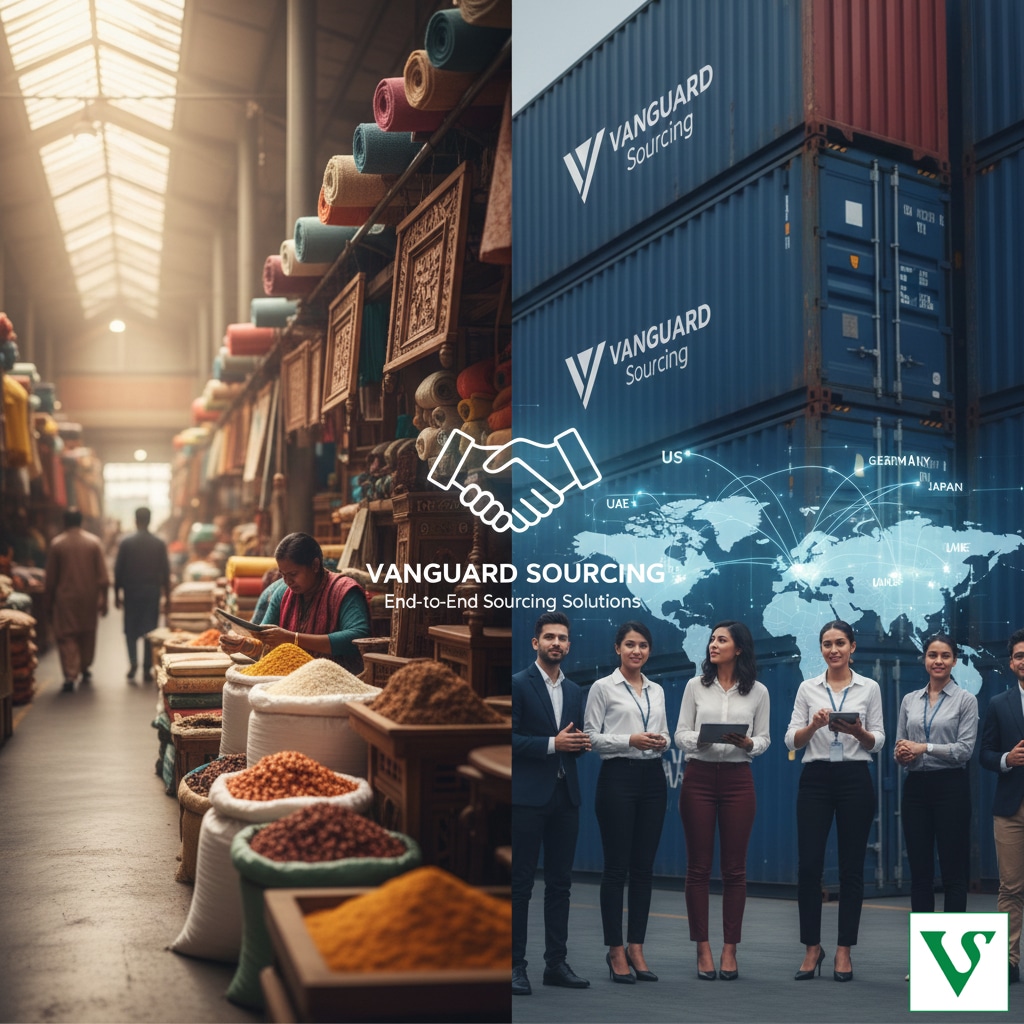
Scandinavian sourcing services help importers, retailers, and product brands in Sweden, Denmark and Norway identify reliable factories in India, develop private-label goods, coordinate production, and manage export requirements. A successful sourcing strategy should balance price with quality, lead time, supply chain transparency, product compliance, and dependable delivery.
For Scandinavian businesses sourcing from India, the question is not only which manufacturer offers the lowest quote. Buyers need a process for comparing factories, approving samples, conducting inspections, validating materials and handling shipment documentation. Vanguard Sourcing supports international procurement projects for categories including home textiles, furniture, hard goods, décor, kitchenware, apparel and accessories.
What are Scandinavian sourcing services?
A sourcing partner helps Nordic buyers plan and manage purchases from overseas suppliers. The scope can cover several stages of a project, depending on the buyer’s products and requirements.
- Manufacturer identification: Research and shortlist Indian factories relevant to the product, material, order size and technical requirements.
- Supplier verification: Review factory identity, capabilities, subcontracting, references, documented processes and available audit evidence.
- OEM and private-label development: Arrange samples, product specifications, labels, branding, packaging and approved reference standards.
- Price and order coordination: Compare quotations, MOQs, tooling, payment terms, realistic production lead times and contract requirements.
- Quality control: Coordinate appropriate production inspections, pre-shipment checks and independent testing when necessary.
- Export support: Organize documentation review, freight communications, shipping milestones and an agreed handover to the importer.
Learn more about manufacturer sourcing in India and India sourcing for European importers.
Scandinavian sourcing for Sweden, Denmark and Norway
Sweden: Indian manufacturing for Swedish brands
Swedish home-living retailers, e-commerce brands and wholesalers may investigate India for textiles, decorative accessories, rugs, wooden products, furniture and OEM collections. Define product specifications and quality expectations in writing, and review the relevant EU product safety, labeling, chemical restrictions and importer requirements before confirming a factory order. For consumer goods, Swedish-language information should be checked where applicable.
Denmark: supplier development for Danish importers
Danish product companies and design-led brands can use an Indian sourcing partner to coordinate sampling, material selection, production consistency, factory inspections and shipment consolidation. For mixed-material products such as wooden furniture with metal fittings, or ceramic and metal kitchenware, different safety and test requirements may apply within one collection. Denmark is in the EU, so product rules, customs treatment, and any Danish market requirements should be assessed together.
Norway: sourcing support with separate customs planning
Norwegian brands can purchase Indian-manufactured goods, but Norway’s import administration differs from Sweden and Denmark. Norway participates in the European Economic Area (EEA) but is not part of the EU customs union. Therefore, Norwegian customs declarations, duty and VAT treatment must be checked separately. Product rules may be aligned with EU rules through the EEA framework, but confirm the relevant rules and implementation for each item.
For authoritative background, consult Norway’s EEA Agreement overview.
Finland, Iceland and the wider Nordic region
Although ‘Scandinavian’ generally refers to Sweden, Denmark and Norway, buyers also use the broader term ‘Nordic’ for Finland and Iceland. Finland is an EU country; Iceland is an EEA country outside the EU customs union. A multi-market sourcing plan should maintain country-specific compliance, customs and customer documentation.
Products Scandinavian buyers can source from India
- Home textiles: Bedding, towels, throws, cushions, curtains and table linens; see apparel and home textile sourcing.
- Furniture and home décor: Wood furniture, metal accessories, lighting, decorative objects and storage products, with material and stability checks as appropriate.
- Rugs and floor coverings: Handwoven, tufted and other collections with specified dimensions, fibers, construction and finishing.
- Kitchenware and tabletop: Metal, wood, glass, ceramic and stone products, subject to relevant food-contact and other use-specific requirements.
- Apparel and private label: Knitwear, woven garments and accessories produced to agreed materials, measurements, labeling and packaging specifications.
- Customized products: Brand-specific designs, finishes and retail packaging, subject to prototyping and factory capability verification.
Supplier selection should follow the product specification rather than the location alone. A factory skilled in decorative metalwork may not be suitable for food-contact products or electrical lighting without the necessary processes and expertise.
Ethical, sustainable and traceable sourcing
Nordic buyers may ask for evidence concerning environmental impacts, supplier working practices or the provenance of materials. Ask for documentation supporting specific product claims instead of accepting general promises that goods are ‘eco-friendly’ or ‘sustainable’.
- Supply chain traceability: Request appropriate records for raw materials, components, subcontractors and processing locations.
- Certificates and claims: Verify the scope, issuing body, expiry, and chain-of-custody rules for any relevant GOTS, OEKO-TEX, FSC or other certification.
- Social-audit programs: Review buyer-required SMETA, amfori BSCI or comparable audit evidence, without assuming an audit guarantees ongoing compliance.
- Product performance: Set measurable expectations for durability, color, construction, safety and package protection.
- Packaging and environmental requirements: Check destination-country rules on packaging, producer responsibilities and marketing claims.
See SMETA audit coordination and sustainable clothing supplier evaluation.
EU and Norwegian compliance: important differences
General product safety and product traceability
The EU’s General Product Safety Regulation (GPSR) applies to products within its scope marketed in EU member countries; it has applied since 13 December 2024. This can affect importer responsibilities, safety information and traceability, alongside any sector-specific legislation. See European Commission product-safety guidance and our EU GPSR buyer guide.
Textile labels, materials and consumer information
EU Regulation 1007/2011 governs fiber-composition labeling for covered textile products. Buyers should confirm required fiber names, composition, any applicable language requirements and label placement before authorizing bulk production. See EU textile label guidance.
Chemical restrictions and product-specific tests
Depending on the product, relevant requirements may include REACH restrictions, food-contact rules, electrical product legislation, furniture stability or other safety assessments. CE marking is not a universal mark for all homewares; it is relevant where specific legislation requires it. Norwegian and EU-market obligations must be confirmed product by product.
Packaging and import responsibilities
Establish the importer of record, the party handling customs clearance, the product labels and required technical files, and any packaging or extended producer responsibility obligations. Country-specific registrations, import VAT and fees can change the total landed cost.
How the India-to-Scandinavia sourcing process works
- Prepare a sourcing brief: Specify product drawings or photos, materials, size, quantity, target price, delivery destination and any required claims or tests.
- Shortlist manufacturers: Compare relevant capacity, factory setup, order size, prior export experience and realistic manufacturing schedules.
- Verify suppliers: Review business details, factory conditions, production capabilities and the scope of any independent audits.
- Approve samples: Confirm construction, finish, measurements, labeling, packaging and technical specifications.
- Agree compliance responsibilities: Document who arranges necessary lab tests, documents, origin evidence and importer information.
- Confirm purchase terms: Sign off price, MOQs, payment milestones, Incoterms, quality standards and production deadlines.
- Inspect production: Monitor key stages and arrange an agreed pre-shipment inspection using product-specific acceptance criteria.
- Coordinate shipment: Review invoices, packing lists, transport documents, carton marks and broker instructions before dispatch.
Vanguard Sourcing’s supplier verification guidance, quality inspection services, and export coordination services can help buyers structure these stages.
How to compare landed costs when importing into Scandinavia
The factory unit price is only one part of the delivered cost. A practical cost model includes development and tooling, product manufacture, inland collection, export handling, international freight, insurance, customs brokerage, relevant duties, import VAT and delivery to the final warehouse. Sweden and Denmark use EU customs processes, while Norway requires its own import procedure.
Ask factories to quote a specified Incoterms rule and named place. Where a DDP quote is offered, clarify which entity can act as importer and handle tax and clearance. For orders combining products from several suppliers, assess shipping consolidation and carton efficiency. Read FOB, CIF and DDP explained and FCL vs LCL freight from India.
Frequently asked questions
Can Scandinavian brands work directly with Indian manufacturers?
Yes. Direct factory sourcing is possible, but brands need capacity to verify suppliers, manage samples, approve quality, and meet destination-market import and product requirements. A sourcing agent can coordinate some of this work under an agreed scope.
Are Nordic sourcing services limited to large orders?
No. Suitability depends on the product and factory. Minimum order quantities vary by material, production method, design complexity and packaging. Provide a realistic volume plan to receive comparable quotations.
Can I develop OEM and private-label goods for a Swedish or Danish brand?
Many Indian manufacturers offer custom development and branding. Product suitability, tooling, samples, intellectual-property terms, labeling and quality standards need to be agreed before a large production run.
Can the same shipment serve Sweden, Denmark and Norway?
A supplier may produce products for all three markets, but customs declarations, delivery terms, languages and some market-specific compliance or tax obligations may differ. Do not assume the same documents are adequate for every destination.
Does a factory certification guarantee legal compliance?
No. A social audit, organic material certification or chemical testing certificate addresses a particular subject or scope. The importer still needs an appropriate product-specific legal and compliance assessment.
Request Scandinavian sourcing services from Vanguard Sourcing
Vanguard Sourcing helps international buyers explore Indian manufacturers, OEM and private-label options, supplier due diligence, sampling, production coordination, quality inspection and export support. If you represent a business in Sweden, Denmark, Norway or the wider Nordic market, share your product category, specifications, estimated order volume, target lead time, required documentation and destination country.
Explore India sourcing solutions for European buyers or request a supplier sourcing review. Indian manufacturers seeking introductions to international sourcing projects can use supplier registration.
Disclaimer: This article provides general commercial sourcing guidance. Requirements vary by product, importer, and destination. Confirm current customs, product-safety, environmental and labeling obligations with qualified professionals before placing an order or shipping goods.